


When was the last time you felt truly creative?
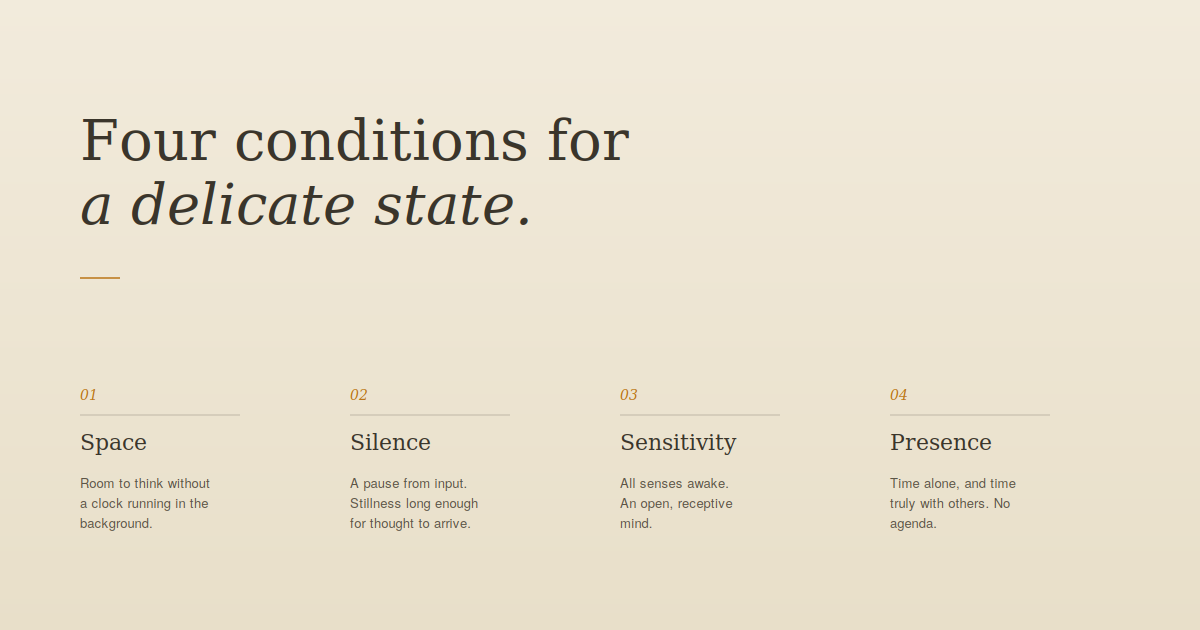
I have been thinking about this for a long time. Looking back at my own life, I can recognize the moments that have helped my creativity, and the ones that have quietly killed it. There is a certain sensitivity in the good ones. All the senses are awake. The mind is open. Nothing is forcing itself through. In those moments, you start to see possibilities where others see routine. But that state does not appear on demand. It needs a certain kind of space around it.
It often starts with silence
For some people, the creative process begins in quiet. With stopping. With letting your own thoughts flow.
Over the years I have spent time with people who make music. One thing connects most of them. Before they can create anything, they need their own space. A space where they can become sensitive again. A space that makes room for feeling.
Think about your own work. How often are you allowed to enter that state? How often does your week make room for it? For most of us, the honest answer is: not very often.
So the bigger question is this. Are we making enough space for creativity in our organizations?
Creativity is personal
It is hard to set rules for creativity, because it is such a personal state. Such a personal way of expressing yourself. Some people find it through their hobbies. Others through their work. Some need to be alone. Others need a group. There is no single recipe.
But there is one thing that all of these have in common. They all need space. And this is one of the biggest challenges of modern working life. How can organizations make room for creativity, and for the personal lives that feed it?
Nikola Tesla, Albert Einstein, John Lennon, Steve Jobs, Rick Rubin, Billie Eilish. Very different people, from very different eras, doing very different things. But when you read what they have written and said about how they work, you find the same words coming up. The need for silence. The value of stepping back. The importance of really listening.
We also create together
Solitude is only half of the story.
The quiet room is where ideas start. But some of the best ones I have been part of needed something more. They came after a real conversation. From someone saying something half-formed, and someone else picking it up, turning it around, adding to it. Creativity also lives in those moments. In genuine presence with another person. No agenda, no slides, no clock running in the background.
So the question is not only whether we make time to be alone. It is whether we make time to truly be together. Not in meetings, but in shared presence. Do we still know how to do that?
What we are at risk of losing
Something important is starting to break.
Many organizations talk about AI as the great accelerator. Faster output. More content. More options. More ideas in less time. And there is real value in that. AI can be a real part of how we create. A UX designer can ask for ten versions of an interface in the time it used to take to draw one. A writer can see five different openings to the same essay in seconds. We can explore more, faster, and that is genuinely useful.
But AI does not know what matters to the person on the other side of the screen. It does not know what they feel, what they have lived through, what they will recognize as true. Those things come from somewhere else. They come from lived experience. From attention. From one person trying to understand another. As long as we are making things for people, that part cannot be outsourced.
This is why AI cannot be where you begin. Filling every quiet moment with another tool, another prompt, another deliverable is not how new ideas are born. It is how they get crowded out.
As I wrote in an earlier post, when everyone can build anything in hours, speed stops being the advantage. What you believe in does. The same is true here. When everyone can generate, only those who can still notice, feel and sense will create something that matters.
This is why I keep coming back to the same thought. Creativity is a delicate state. It does not survive constant noise. And it does not survive being treated as just another deliverable.
What I would look at first
If I walked into any organization tomorrow, these are the questions I would start with.
- Do we talk about creativity and why it matters?
- What does creativity actually mean to us?
- Do we notice what people are good at outside of work?
- Do we leave time, real time, not just slots between meetings?
- Do we make space for genuine presence with each other?
- Do we talk about feelings, not only about results?
- Are we doing enough, in practice, to protect the creative state?
- Do we encourage people to find new solutions, and to care about the work like it is their own?
None of these questions can be answered with a slogan. They are only answered by how an organization actually behaves on a normal Monday.
The honest trap
We keep telling ourselves that AI will free up time for creative work. And maybe it will. But unless we actually make space for creativity, we are only fooling ourselves. The time gets freed and then immediately filled with more of the same. More tasks. More meetings. More output. The creative state never arrives, because we never built a place for it to land.
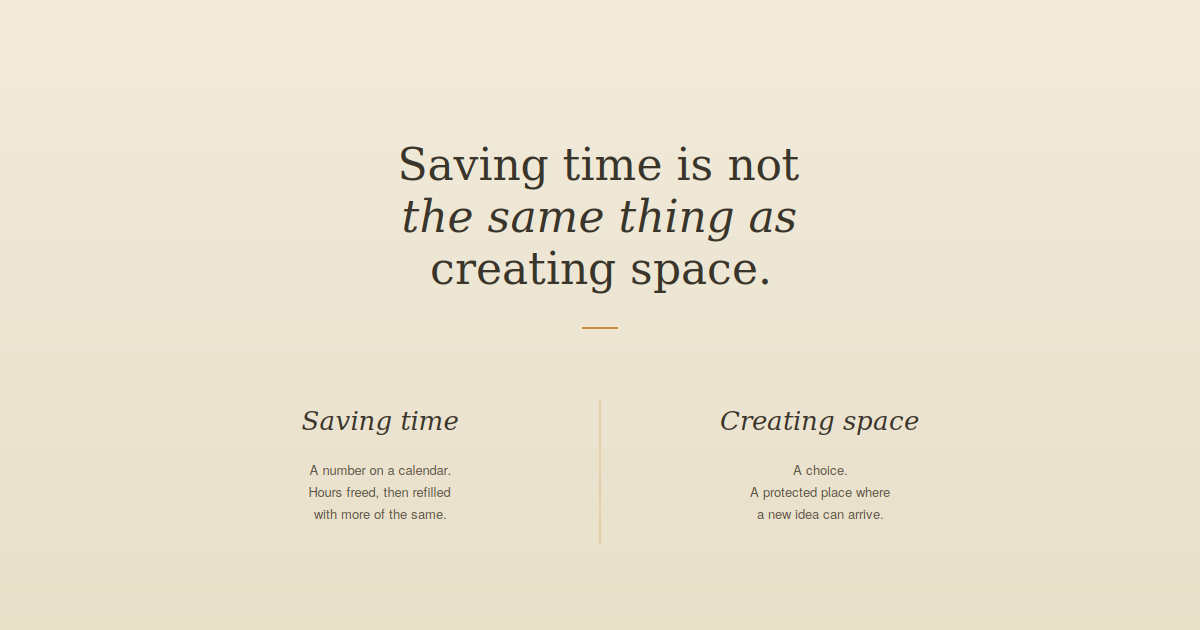
Saving time is not the same thing as creating space. One is a number on a calendar. The other is a choice.
Where to start
You do not need a strategy to start. You only need to notice.
Notice when you feel creative. Notice what came before it. Notice what tends to interrupt it. And then, slowly, protect those moments. For yourself first, and then for the people around you.
Because the most valuable thing in the years ahead will not be the fastest output. It will be the people, and the organizations, that still know how to be quiet long enough to hear a new idea arriving. And from those moments, ideas can grow that no one could have reached alone.
We are all creative. We just need to make room for it.


Discussion